

"Three kids means three birthday lists plus Christmas. Before this, my family would text each other asking 'did you already get the LEGO set?' Now they just check the list. Problem solved."
WishApp
Giftwhale vs WishApp
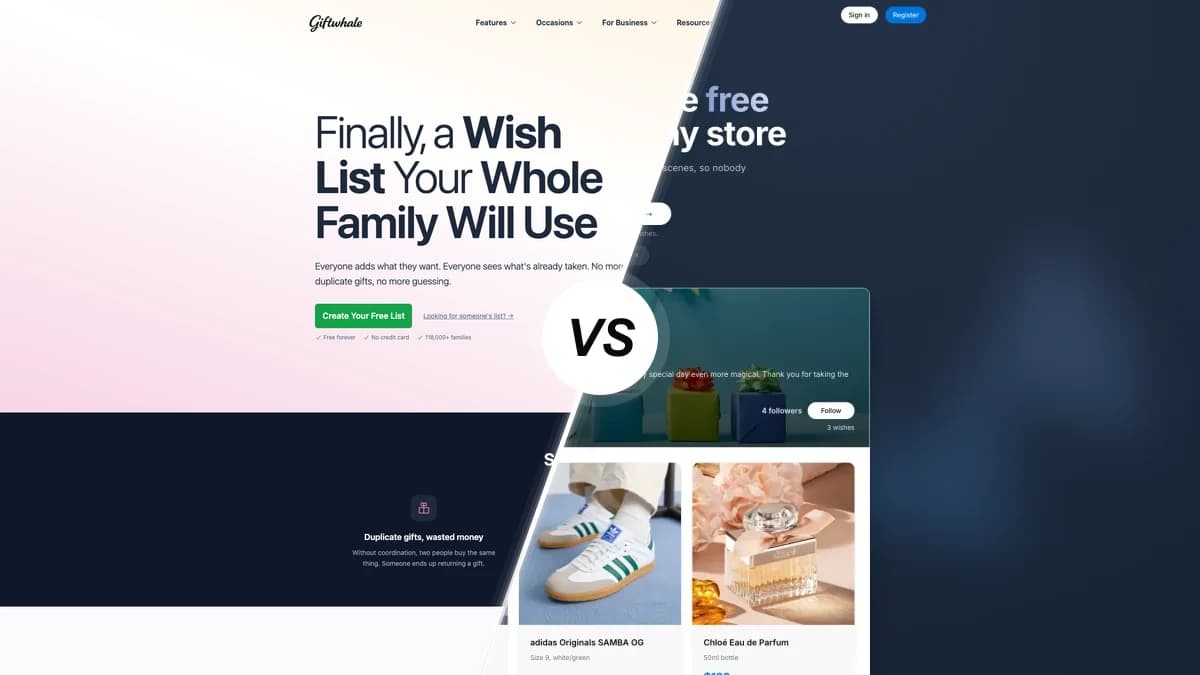
Giftwhale is a bootstrapped, completely free wishlist app built by brothers Tom and Matt Buckland in the UK. WishApp is also free, also independent. But there are real differences. Here's an honest look at both.
We built WishApp, so we're biased. But we'll be honest.
Last updated: February 2026
The quick version
- Completely free. No paid plans, no hidden costs.
- Secret Santa with auto name drawing, budget limits, and exclusion rules
- Group gifting for splitting big-ticket items
- Child accounts for family members, plus a Thank You function for marking gifts received
- Works with any online store, not just selected ones
- Native iOS and Android apps, not just a PWA
- Hidden reservations keep gifts a surprise
- 55 languages and collaborator support for shared lists
Feature-by-feature comparison
How Giftwhale and WishApp stack up on the things that actually matter.
| Feature | Giftwhale | WishApp |
|---|---|---|
| Free to use | ||
| Native mobile app | ||
| Browser extension | ||
| Auto-fill from product URL | ||
| Hidden reservations | ||
| Group gifting | ||
| Secret Santa organizer | ||
| Child accounts | ||
| No account to view lists | ||
| No ads or trackers | ||
| Thank You function | ||
| Price tracking | ||
| Share via QR code |
What actually sets them apart
Native apps vs a PWA
Giftwhale has no native iOS or Android app. It runs as a Progressive Web App, which means you can add it to your home screen, but it's still a browser tab underneath. WishApp has actual native apps. That means faster performance, proper push notifications, and an experience that feels like a real app because it is one.
Giftwhale's Secret Santa is genuinely good
Honestly. Secret Santa on Giftwhale handles auto name drawing, budget limits, and exclusion rules. And only the organizer needs an account. If you're running holiday exchanges for a big group, that's a real advantage. WishApp has Secret Santa too, but Giftwhale's implementation has more configuration options.
Child accounts for the whole family
This is Giftwhale's most distinctive feature. You can create and manage separate profiles for kids, grandparents, and even pets, all under one main account. Each gets their own page with multiple wishlists. WishApp doesn't have this. If you're managing gift lists for a whole family across several people, that's a genuine reason to pick Giftwhale.
Both are free. The revenue model differs.
Giftwhale is transparent about how it makes money: affiliate commissions on product links, confirmed on their FAQ page. WishApp works the same way. So neither is hiding anything. The practical question is which product fits your workflow, not which one has a sketchy business model.
When to pick each one
- Want child accounts so younger family members all have their own lists
- Need advanced Secret Santa features like exclusion rules and budget limits
- Like the Thank You function for tracking gifts received and sending messages
- Are fine with a PWA and don't need a native mobile app
- Want a native mobile app rather than a browser-based experience
- Want proper push notifications that actually work on iOS
- Care about fast performance and an experience that feels built for your phone
- Are looking for something actively developed with a growing user base
52,000+ wishlists and 150,000+ gifts reserved for birthdays, weddings, and every occasion worth celebrating
"My girlfriend and I share lists with each other. I can reserve stuff without her knowing, which makes birthdays way less stressful. The hidden reservation thing is actually clutch."
"We used this instead of a traditional registry. Added items from 11 different stores. Stuff we actually wanted, not just whatever one store had. Our guests said it was easier too."
Frequently asked questions
Giftwhale vs WishApp: the full picture
What Giftwhale has built since 2014
Giftwhale launched in 2014, built by brothers Tom and Matt Buckland through their UK company Giftwhale Ltd (registered number 15384054). It's been free for every user since day one, with no premium tier and no paid plans. The product covers the core wishlist use case: add items from product links, share via links or QR codes, let friends claim gifts without the list owner seeing what's been taken. Giftwhale 4.0 added child accounts and profile pages. The company reported 30% year-over-year growth in 2025. Their Chrome extension currently holds a 5.0/5 rating on the Chrome Web Store, though Firefox and Safari users are limited to a bookmarklet. No Trustpilot reviews exist. The team says they're focused on trust and refinement going forward.
Where WishApp takes a different approach
WishApp has native iOS and Android apps. Giftwhale doesn't. That's the most practical difference for most people. Both let anyone view a wishlist without signing up. And both are transparent about affiliate commissions as the revenue source. So this isn't a story about one being shady and the other not. It's about which product fits your actual habits. If you live on your phone and want a real app, that's WishApp. If you need child accounts for the whole family, or a more configurable Secret Santa, Giftwhale is genuinely strong there.
Which one should you actually pick?
If you need child accounts or Giftwhale's more configurable Secret Santa, those are real reasons to pick Giftwhale. Both apps are free. Both handle the basics well. The Thank You function on Giftwhale is also a nice touch you won't find in WishApp. But if you want a native app rather than a PWA, and proper push notifications that actually work on iOS, that's WishApp. Try both before deciding. Neither asks for a credit card.
Start your free wishlist from any store
Create your first wishlist in under 60 seconds. Free forever, no ads.
Create my wishlist →