

"Three kids means three birthday lists plus Christmas. Before this, my family would text each other asking 'did you already get the LEGO set?' Now they just check the list. Problem solved."
WishApp
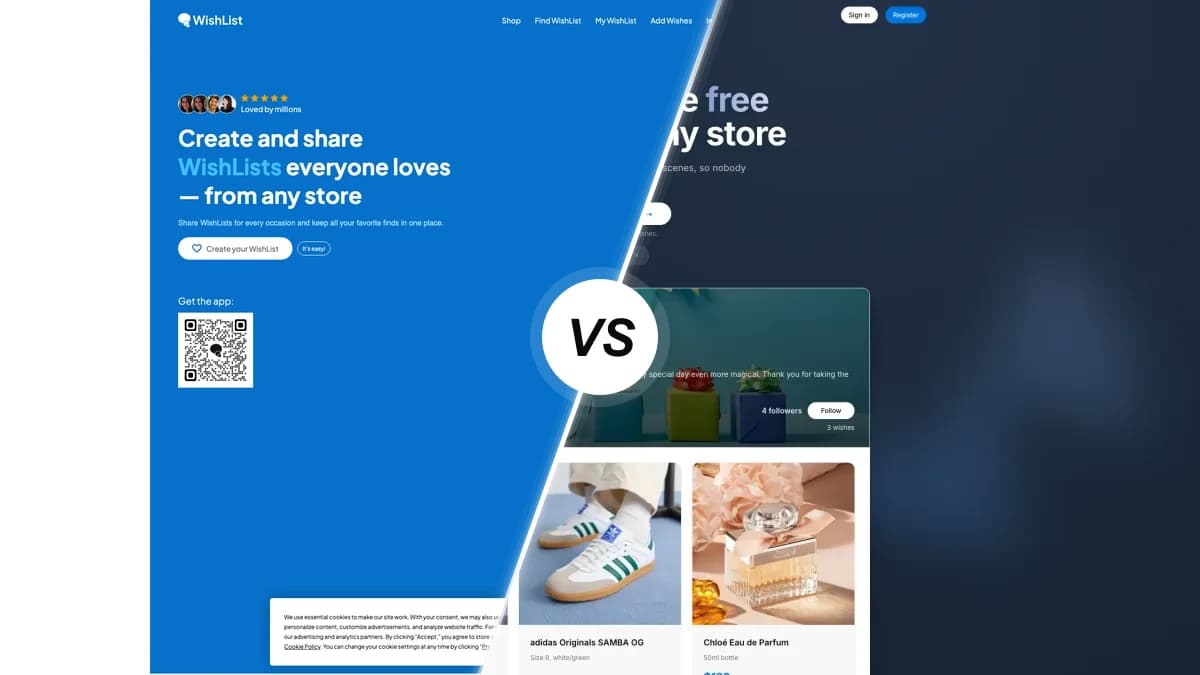
Wishlist.com vs WishApp
Wishlist.com launched in 1998. That's not a typo. It's been running for 27 years on a team of about 7 people, pulling in roughly 401K monthly visitors on the strength of a premium domain name. WishApp is newer, faster, and built for how people actually share gift lists today. Here's the honest comparison.
We built WishApp, so we're biased. But we'll be honest.
Last updated: February 2026
The quick version
- Founded in 1998, one of the oldest wishlist platforms on the internet
- ~401K monthly visitors (December 2025, per Semrush)
- iOS and Android apps plus Chrome, Firefox, and Safari browser extensions
- Free for consumers, with B2B gift registry services for retailers
- Works with any online store, not just affiliate partners
- Zero ads, zero trackers, zero data selling
- Hidden reservations keep gifts a surprise
- Free forever with no premium tier
Feature-by-feature comparison
How Wishlist.com and WishApp stack up on the things that actually matter.
| Feature | Wishlist.com | WishApp |
|---|---|---|
| Ease of use | ||
| Mobile app | ||
| Browser extension | ||
| Works with any store | ||
| Hidden reservations | ||
| Group gifting | ||
| Secret Santa | ||
| Collaborative wishlists | ||
| No account to view lists | ||
| No ads or trackers | ||
| Free (no premium tier) | ||
| Active development | ||
| Fast performance | ||
| Price tracking |
What actually sets them apart
Built in 1998 and it shows
Wishlist.com launched the same year Google did. That's a remarkable run. But the platform looks and feels like it hasn't had a serious design update in years. Users describe it as dated, and with only ~7 employees and no external funding, there's no obvious force pushing it forward. WishApp is newer and actively developed. The interface is clean, the mobile experience is built for today, and features are still being added.
No group gifting, no Secret Santa, no collaboration
Wishlist.com does the basics: add items, share a list, let friends see what you want. But it stops there. No Secret Santa draws. No group gifting where multiple people chip in on one item. No collaborative wishlists. WishApp has all three. For families and friend groups who actually coordinate gifts, that difference matters a lot.
Reservations that actually protect surprises
Wishlist.com doesn't appear to have hidden reservation functionality. Friends can see your list, but there's no clear way to claim an item invisibly so the gift stays a surprise. WishApp built hidden reservations from day one. Your friend reserves something, you see the item is taken, but you have no idea who reserved it or when. The surprise survives.
Traffic from a domain name, not from product quality
Get this: roughly 401K people visit Wishlist.com every month. But a lot of that traffic comes from the domain itself. Wishlist.com is a premium URL, the kind that ranks just because of what it's called. With traffic declining about 4% month-over-month in late 2025 and no visible investment in the product, it looks more like a platform coasting on a great domain than one actively competing. WishApp earns its users by actually being good.
When to pick each one
- Want something extremely simple with no learning curve
- Only need basic sharing and don't need gift coordination features
- Prefer a no-frills tool that's been around longer than most social networks
- Are already using it and it covers everything you need
- Need hidden reservations so gifts stay a surprise
- Want group gifting, Secret Santa, or collaborative wishlists
- Care about a modern interface that feels good to use
- Want a platform that's actively being built, not just maintained
52,000+ wishlists and 150,000+ gifts reserved for birthdays, weddings, and every occasion worth celebrating
"My girlfriend and I share lists with each other. I can reserve stuff without her knowing, which makes birthdays way less stressful. The hidden reservation thing is actually clutch."
"We used this instead of a traditional registry. Added items from 11 different stores. Stuff we actually wanted, not just whatever one store had. Our guests said it was easier too."
Frequently asked questions
Wishlist.com vs WishApp: the full picture
What Wishlist.com actually is
Wishlist.com launched in 1998, founded by Keith Kraemer in California. It's one of the oldest universal wishlist platforms on the internet, built before most people had broadband. The platform pulls roughly 401K monthly visitors (December 2025, per Semrush), largely on the strength of its premium domain. The company runs on a team of about 7 people with no external funding. Revenue comes from affiliate commissions and B2B gift registry services sold to retailers and malls. No major news, acquisitions, or product updates have come out in recent years.
Why WishApp is built differently
WishApp started with a different question: what does a wishlist need to do in 2024, not 1998? The answer included hidden reservations so gifts stay secret, group gifting so friends can chip in together, Secret Santa draws for family exchanges, and a mobile experience that actually feels good. WishApp has no ads, no affiliate tracking, and no B2B services that could shift priorities away from the product. The whole thing is built for the person sharing a list and the friends trying to buy from it.
Which one should you actually pick?
Wishlist.com works. If you want dead-simple and don't need coordination features, it'll do the job. But honestly, if you care about gift surprises, group coordination, or just using something that's being actively improved, WishApp is the better fit. Try it free. Your friends don't need accounts to see your list, there are no ads in their way, and the whole thing takes about two minutes to set up.
Start your free wishlist from any store
Create your first wishlist in under 60 seconds. Free forever, no ads.
Create my wishlist →